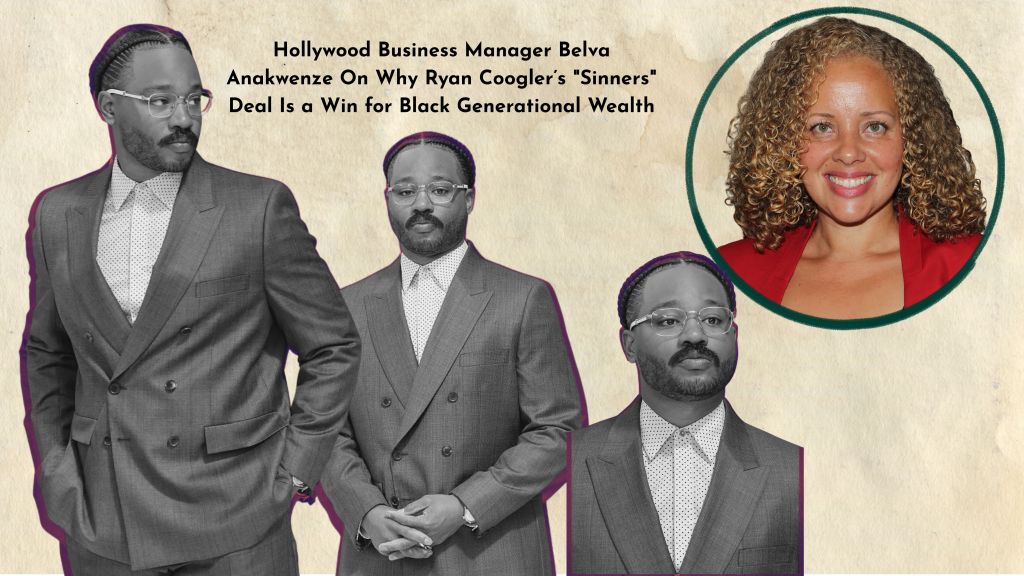
Ryan Coogler’s 'Sinners' Deal Is a Win For Generational Wealth
Top Black Woman Hollywood Business Manager on Why Ryan Coogler’s "Sinners" Deal Is a Win for Black Generational Wealth
- Belva Anakwenze advocates for Black creatives to prioritize IP ownership to build generational wealth, citing Ryan Coogler's industry-disrupting Sinners deal.
- Studios often use predatory contract language to restrict creatives' ownership, so Anakwenze advises monitoring rights, residuals, and using AI to spot issues.
- Growing up in 1990s South Central, Anakwenze learned early to thrive in spaces not built for her, preparing her to demand her worth in the sports and entertainment industries.
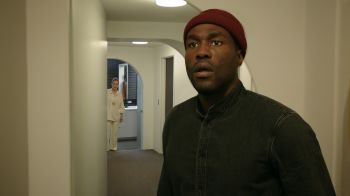
When Hollywood “wealth whisperer” Belva Anakwenze is asked to describe her upbringing, the best picture she can conjure up is John Singleton’s imagining of 1990’s South Central, Los Angeles. Boyz n the Hood, the semi-autobiographical work from Singleton’s film canon, is critically acclaimed for its realistic depiction of inner-city life in post-Reganomics L.A., an era marked by community care, racial injustice, systemic poverty, and gang crime. By the time the movie dropped in summer of 1991, Anakwenze was growing up right in the middle of the sprawling urban jungle, living in a small, ceiling-less house (you could see the rafters) on a street in View Park with her parents and sisters. While some of her childhood memories include huddling around stove eyes for heat or going to bed hungry, Anakwenze says her family was rich in ways that weren’t materially visible.
“My parents were very strict on two things: one was family and taking care of each other and then the other was education,” Anakwenze told HelloBeautiful. In fact, her parents were so serious about schooling, Anakwenze said they jumpstarted her financial education by enrolling her in a business-focused high-school that taught bookkeeping courses and stock market games. “I was miserable when they selected it, because it was a very small high school,” Anakwenze said. “It was like literally in a warehouse that had been converted to a high school. No football team. I wanted the high school experience,” she said. But her parents saw a “normal” high school experience as a short-term sacrifice for a long-term generational gain: financial literacy. Anakwenze said that even though her mom was at home and her dad drove the L.A. bus route, the couple still managed to acquire real estate on their meager earnings, but the properties never stayed in the family for long, leaving her, and her siblings, with “absolutely nothing” when their parents died. It’s a generational pattern Anakwenze is rewriting in real time, for the sake of her own legacy, and the legacy of the Hollywood creative wealth portfolios she now manages as founder and principal of Abacus Financial business management. When asked what’s top-of-mind for her as a Black business manager during a markedly tumultuous time for the entertainment industry (between 2024 and 2025, shooting days in L.A. have dropped more than 20%), Anakwenze chants “ownership, ownership, ownership, ownership, ownership,” like a tribal drumbeat.
Ryan Coogler’s Sinners studio deal is a case study in how disruptive Black ownership can be in an industry that props itself up on creative vampirism (pun intended). For generations, Black artists (think Elvis Presley’s theft of blues icon Big Mama Thorton’s hit, “Hound Dog”) have served as creative sharecroppers for Hollywood — doing all the labor, but owning and passing down nothing. But Coogler flipped that exploitative narrative on its head when he signed a deal with Warner Brothers that granted him three key advantages: creative control over Sinners’ final cut, first dollar gross (meaning, Coogler’s Proximity Media made money the moment the first Sinners box-office ticket was sold, versus waiting to profit after investors recoup their estimated $90 million spend), and ownership rights that revert back to Coogler after 25 years. The contract was dubbed, “The Movie Deal That Made Hollywood Lose Its Mind,” by an opinion writer at The New York Times and was fear-mongered by press as a move that would “end the studio system,” even though other acclaimed directors, like Quentin Tarantino, have constructed similar contracts. In a February 2026 interview, Oscar winning actor and director Ben Affleck said Coogler played a hand that was “very smart, very innovative” and “controversial,” adding, “a lot of people on the studio side were mad at Warner Brothers” because the deal drives long-term profitability away from the studio and ultimately back into the pockets of the Coogler Proximity Media empire. Affleck explained that studios bet on a “long tail” revenue model which shifts the focus of profitability away from initial box office numbers and deeper into distribution, streaming, and franchising (think, merch, theme park attractions). “People will still license that movie for $10-20 million to Netflix or Prime or Max that’s been out a long time…because people will still watch it, and it’s a big, big hit,” Affleck said, adding, “[Coogler] bet on himself. And really now accrues the value of that.”
When Coogler was asked in a 2025 interview with Democracy Now! why he believes his deal was such an industry upset, Coogler said that he was “not the first filmmaker” to negotiate a deal of this magnitude. Indeed, Coogler’s Sinners deal structure mirrors similar contracts arranged between studios and directors/writers like Christopher Nolan, Steven Spielberg, and George Lucas, an earnings tier Coogler rightfully stands on after creating films that have grossed over $2.5 billion at the global box office (Fruitvale Station, Black Panther & Creed franchises, Judas and The Black Messiah). “I think a lot has been made of my deal in particular,” Coogler said. “I’m not totally sure why, but like, I have my guesses,” he said. With Sinners now being the most Oscar-nominated film in history, Coogler’s demand for final ownership of the film’s IP is beyond audacity; it’s birthright. Sinners, set in cotton fields of the Jim Crow South, is an ancestral love story to Delta Blues and Coogler’s Mississippi family ties, and that rich history can’t be sold.
“It changes the money story of his children, his grandchildren, his great grandchildren,” Anakwenze said. “We are going to know about John Landis (Twilight Zone) for the next 100 years. We’re going to know about George Lucas (Star Wars) for the next 200 years. We’re going to know about Quentin Tarantino (Pulp Fiction, Kill Bill), and his very niche way in which he does cinema. We’re going to know about that for the next 200 years. And Ryan’s going to be in that same place, because of the breadth of work and because of the norm bending he has done. And now his family, if they are good stewards, and listen to the right people, can create generational wealth. I mean, generational wealth, wealth, wealth.”
Anakwenze said the rich keep their wealth tied up in IP (intellectual property), whether it’s art hanging at home or on exhibit walls, film IP, or music masters. “When you look at people’s balance sheets, you’re talking about the uber wealthy, it’s not because they have X amount of dollars in the bank account, or in their investment accounts, or they have this many pieces of property. Those things are all part of the narrative, but a lot of it’s IP,” she said. A common predatory practice of studios is to write contracts that are loaded with language that creates barriers to ownership — the system depends on creatives not understanding the “business” part of the industry. “The entertainment business is a business, so it should be treated as such,” Anakwenze said. “Oftentimes, creatives are so busy being creative that they’re forgetting that they’re actually in business.”
She encourages creatives to work with business managers who are trained in what she calls the “financial arts,” monitoring market trends, accounting, forecasting, investing, budgeting, and estate planning. But if a creator doesn’t have resources to afford additional assistance, there are some red flags they can spot on their own, she said, by interrogating rights, residuals, and usage terms and even dropping contracts into AI tools that can point out problematic clauses that can hold a creative “hostage.” Anakwenze references Prince, who in the mid-90’s, wrote the word “slave” across his cheek, signaling the musical “indentured” servitude he felt bound to contractually during his career. “IP shapes culture. Art shapes culture, period. And so when you own art, IP, tangible art, whatever, you also get to shape culture,” she said.
But the pioneers of cultural change often bear the blunt force cost of progress. In 1982, during a stint while her father was imprisoned, Anakwenze said she and her sister were briefly sent to live with her mother’s brother in rural Ruthstown, Ohio. The sisters were the first Black girls to ever integrate the church and local school. The subtly hostile environment would serve as an elementary playground for Anakwenze to learn how to survive and thrive in spaces not built for anyone “other.” Decades later, the UCLA alumni would find herself early in her career on a bigger playground — the sports industry —- managing NBA stars’ financial portfolios and navigating client meetings in packed, game-day hotel lobbies flooded with groupies and competing white, male, financial business managers. Anakwenze’s whole life has been a testimony on what it looks like to not fit in while holding the courage to walk in purpose and competitively demand her worth, anyway.
In a cinematic nod to fair compensation, at the beginning of Sinners, Smoke coaches a little Black girl from Shelby on the art of the deal after he asks her to watch his truck parked outside the Bow family Chinese grocery store in Clarksdale. When they agree on 20 cents for the job, Smoke says, “See. We talkin numbers now. And numbers always gotta be in conversation with each other. You understand? You gotta negotiate.” The fictional scene serves as a real-life financial lesson and cautionary tale: in systems built on your oppression, getting what you deserve is not something you wait to be offered, you take it. While we have yet to see reparations for our enslaved ancestors’ unpaid contributions to the wealth of America, maybe our generation’s “lick back” looks different and shows up like this: safeguarding Black creative IP from vultures (ahem, vampires) for the immediate future and beyond.
Keyaira Kelly is a writer and editor who lives between NY & LA. The founder of KK Media, Kelly’s company produces podcasts (Talk To Your Mom) and holds community workshops that encourage intergenerational conversation. She also serves as contributing writer to sites like Elle.com & Refinery29. You can follow more of her words and work @keyairakelly on IG or subscribe to @keyairakellymedia on YouTube.
Top Black Woman Hollywood Business Manager on Why Ryan Coogler’s "Sinners" Deal Is a Win for Black Generational Wealth was originally published on hellobeautiful.com