Ebola Warning Issued: What You Need To Know - Page 5
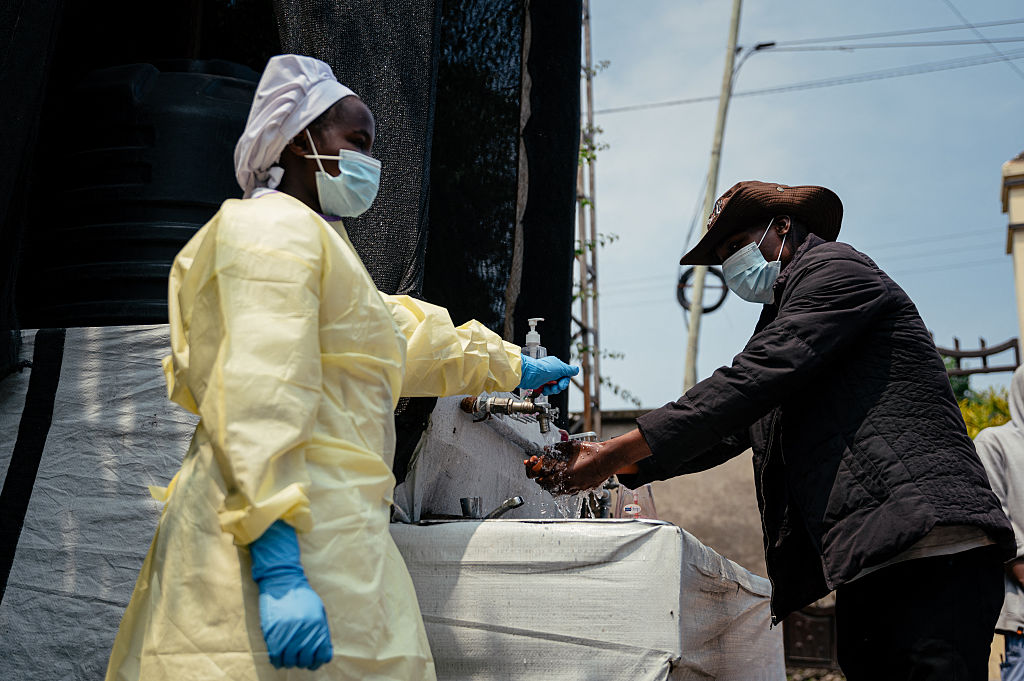
The deadly Ebola virus strikes fear into the hearts of anyone who remembers the devastating outbreak that lasted from 2014 – 2016 and killed over 11,000 people, mostly in sub-Saharan Africa.
Now Ebola has broken out again, this time in the Democratic Republic of the Congo, which NBA fans will remember as the late Dikembe Mutombo’s home country. So far, it’s not believed that the Ebola virus is a threat to the U.S. However, the World Health Organization has declared it a “public health emergency of international concern.”
It was announced Monday that an American doctor in the Congo is one of the confirmed cases, and seven Americans in the region have been transported to Germany after testing positive for the virus, per an Associated Press report.
The latest outbreak is centered around Bunia in the Ituri province in the DRC, which is close to the Ugandan border. On April 27, a 59-year-old man died at Kibuli Muslim Hospital in Kampala, Uganda, marking the first case outside of the Democratic Republic of the Congo. More than 80 people have now died in the DRC.
The U.S. State Department issued a travel advisory that warns Americans to avoid the Ituri region. It’s currently listed as a Level 4 threat. They have also advised those already in the area to have medical evacuation insurance, as the U.S. government will not be able to assist if travelers need it. They also advised enrolling in the Smart Traveler Enrollment Program to receive updates.
Given the remoteness of the area where the outbreak has started, the WHO and health officials in Africa are hoping to contain the spread. The WHO has sent a team of 35 experts, including epidemiologists and laboratory technicians. They also sent seven tons of supplies. Africa CDC is coordinating its response as well.
The declaration by WHO is to coordinate an international response and allot funds to help stem the virus. Early cases have been identified as the Bundibugyo strain, which is rare and has no vaccine or treatment.
“There are significant uncertainties to the true number of infected persons and geographic spread associated with this event at present,” WHO Director-General Tedros Adhanom Ghebreyesus said, per AP. “In addition, there is limited understanding of the epidemiological links with known or suspected cases.”
The Ebola virus is spread between people in close quarters, usually through blood, semen, or vomit. It can often be fatal. Based on multiple reports, additional complications have arisen because the area from which the virus is emerging is in turmoil due to an ongoing conflict.
It is also a mining town, which experts say makes it difficult to track transient workers. And because it appears that the outbreak likely occurred a few weeks before it became known, there may be others who were exposed and cannot be traced.
Several reports say that the dismantling of USAID was a factor in the initial delay in identifying the virus, as part of the federal agency’s role was to monitor outbreaks overseas.
Jeremy Konyndyk, now president of Refugees International, is the former lead of the COVID response team for USAID. On X, he posted that this outbreak could be worse than the 2014-2016 outbreak, which killed thousands but was largely contained in Africa.
“Most of the international infrastructure that we relied on in past outbreaks…has been DOGE-d,” Konyndyk posted. “In 2014, USAID and CDC, supported by the U.S. military, led the international response. USAID is gone, and CDC is decimated.”
Though the Centers for Disease Control is cooperating with WHO, its thinned ranks could hamper a U.S. response if it becomes necessary. Ebola has a 25 – 90% fatality rate.
The Ebola outbreak comes on the heels of the hantavirus outbreak on the cruise ship MV Hondius, which has already killed three people. The ship is now docked in Rotterdam, where it’s being cleaned and disinfected after 120 people were evacuated from it in the Canary Islands.
Those passengers are being quarantined at locations around the world, as symptoms can show up up to eight weeks after exposure.
As for Ebola, Dr. Paul Spiegel, director of the Center for Humanitarian Health at Johns Hopkins University, told Newsweek that while the risk to the U.S. is low, he echoed concerns about the challenge of slowing down the outbreak.
“This current outbreak emerged in a conflict zone in eastern DRC, and it likely went undetected for several weeks before it was reported,” he said. “That delay is the part that should worry us. The global systems that catch outbreaks at source, before they cross borders, are exactly what keep Americans safe. Right now, those systems are being cut, not strengthened. That is one of the most important points of this evolving outbreak.”
See more updates and social media’s reaction to the outbreak below.
Ebola Warning Issued: What You Need To Know - Page 5 was originally published on cassiuslife.com