Black Women Who Broke Barriers and Opened Doors - Page 6
Their ceilings became stepping stones, and limitations became launching pads, see the black women who broke barriers and opened doors.
Share the post
Share this link via
Or copy link
From courtrooms to outer space, from concert halls to the halls of Congress, these extraordinary black women did not just break barriers they dismantled them, rebuilt what came after, and made the impossible inevitable for those who followed. They walked into rooms that were never designed with them in mind and left behind blueprints for generations to come. With courage as their compass and resilience as their rhythm, they challenged systems, redefined expectations, and turned resistance into momentum.
They were told “no” in a thousand different ways and answered back with undeniable excellence. Every milestone they reached was more than personal triumph; it was a collective victory and a path for others who dared to dream just as boldly. Their legacies are not confined to history books or headlines they live on in every door now opened a little wider, every voice now heard a little louder.
Their ceilings became stepping stones, and limitations became launching pads, take a look at the black women who broke barriers and opened doors for others to follow.
Constance Baker Motley – 1966
Born in New Haven, Connecticut, Motley became the first Black woman to argue a case before the U.S. Supreme Court and was instrumental in the legal battles for civil rights, helping to desegregate the University of Mississippi. In 1966, President Lyndon B. Johnson appointed her as a federal district court judge, making her the first Black woman to sit on the federal bench. Her decisions on the bench continued to advance civil rights and equality for decades.
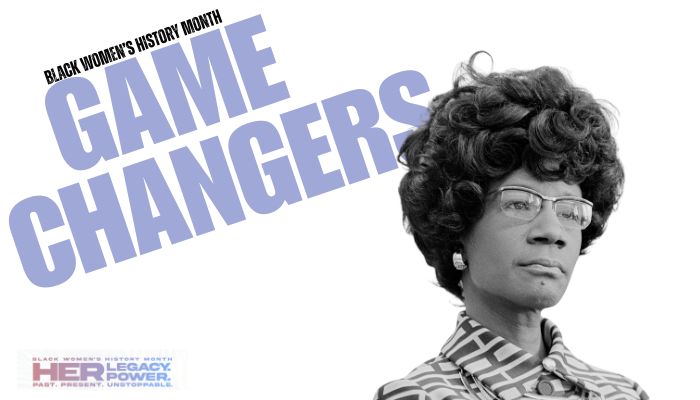
Shirley Chisholm – 1968 & 1972
Shirley Chisholm shattered two barriers at once when she became the first Black woman elected to the U.S. Congress in 1968, representing New York’s 12th congressional district. Her bold motto was “Unbought and Unbossed.” In 1972, she went further, becoming the first Black American and the first woman to seek the Democratic Party’s presidential nomination, competing in primaries across the country. She won 152 delegate votes at the convention and proved that neither race nor gender was a barrier to national ambition.
Patricia Roberts Harris – 1977
A lawyer, diplomat, and trailblazer, Patricia Roberts Harris made history as the first Black woman to hold a U.S. Cabinet position. President Jimmy Carter appointed her Secretary of Housing and Urban Development in 1977, and she later served as Secretary of Health, Education and Welfare. She was also the first Black woman to serve as a U.S. Ambassador, appointed by President John F. Kennedy in 1965 to represent the country in Luxembourg.
Condoleezza Rice – 2001 & 2005
Condoleezza Rice grew up in segregated Birmingham, Alabama, and rose to become one of the most powerful people in the world. She served as the first Black woman—and the first woman—to hold the position of U.S. National Security Advisor under President George W. Bush (2001–2005). She then became the 66th U.S. Secretary of State in 2005, the second Black person and second woman ever to hold the role. A concert-level pianist, she also had a distinguished academic career as a Soviet and Russian expert.
Kamala Harris – 2021
The daughter of a Jamaican father and an Indian mother, Kamala Harris made history on January 20, 2021, when she was sworn in as the 49th Vice President of the United States the first woman, first Black American, and first person of South Asian descent to hold the office. Prior to her election, she served as California’s Attorney General and as a U.S. Senator. Her historic swearing-in was widely celebrated as a landmark moment in American democracy.
Ketanji Brown Jackson – 2022
On April 7, 2022, the U.S. Senate confirmed Ketanji Brown Jackson as an Associate Justice of the Supreme Court of the United States, making her the first Black woman in the Court’s 233-year history. A graduate of Harvard College and Harvard Law School, she clerked for Justice Stephen Breyer, whom she later succeeded. Known for her meticulous legal reasoning and grace under pressure, her confirmation hearings were watched by millions around the world.
Rebecca Lee Crumpler – 1864
Rebecca Lee Crumpler defied every social barrier of her era when she earned her medical degree from the New England Female Medical College in 1864, becoming the first Black woman in American history to become a physician. After the Civil War, she moved to Richmond, Virginia, where she provided medical care to freed enslaved people who had no other access to healthcare. She also authored A Book of Medical Discourses in 1883, one of the earliest medical texts written by a Black American.
Mae C. Jemison – 1992
Mae Jemison is a physician, engineer, and astronaut who became the first Black woman to travel to space when she flew aboard Space Shuttle Endeavour on September 12, 1992, as part of the STS-47 mission. A graduate of Stanford University and Cornell Medical College, she served as a Peace Corps medical officer before being selected by NASA. After leaving NASA, she founded the Jemison Group to encourage science and technology in developing nations, and continues to advocate for STEM education.
Alexa Canady – 1981
Alexa Canady became the first Black woman in the United States to become a neurosurgeon when she completed her residency in 1981. She specialized in pediatric neurosurgery and spent much of her career at Children’s Hospital of Michigan, where she became Chief of Neurosurgery. Her pioneering work helped children with hydrocephalus, brain tumors, and other neurological conditions. She has spoken about facing both racism and sexism in her field and persevering through both with extraordinary skill and dedication.
Kizzmekia Corbett – 2020
Dr. Kizzmekia Corbett, a viral immunologist at the National Institutes of Health, became one of the scientific heroes of the COVID-19 pandemic when she led the team that developed the Moderna vaccine, one of the first vaccines to receive emergency use authorization. A graduate of the University of Maryland and UNC Chapel Hill, she has been recognized globally for her role in saving millions of lives. In 2021, she joined Harvard’s T.H. Chan School of Public Health as an assistant professor, continuing her research on viral threats.
Hattie McDaniel – 1940
Hattie McDaniel made history at the 12th Academy Awards on February 29, 1940, becoming the first Black person and the first Black woman ever to win an Oscar, receiving the Best Supporting Actress award for her role as Mammy in Gone with the Wind. Her win was bittersweet: she was not allowed to attend the film’s premiere in Atlanta due to segregation, and at the ceremony itself she was seated at a segregated table at the back of the room. Despite the injustice, her win was a milestone that she wore with pride and dignity.
Dorothy Dandridge – 1955
Dorothy Dandridge was a stunning actress and singer who became the first Black woman to be nominated for the Academy Award for Best Actress for her leading role in Carmen Jones (1954). Long before her nomination, she had performed in the Cotton Club and headlined Las Vegas casinos though she was not permitted to stay in the same hotels where she performed. Her groundbreaking career, marked by both brilliance and the painful limits of racial discrimination, was later honored with a U.S. postage stamp. Halle Berry’s 2002 Oscar win was widely dedicated to her legacy.
Diahann Carroll – 1968
In 1968, Diahann Carroll broke new ground when she starred in NBC’s Julia, becoming the first Black woman to headline her own television series in a non-stereotypical role. She played Julia Baker, a widowed nurse and single mother, a portrayal of a dignified, professional Black woman that had never before been seen in American prime time. Carroll was also the first Black woman to win a Tony Award for Best Actress in a Musical, for No Strings (1962). Her trailblazing career spanned six decades and included a Golden Globe win for Julia.
Whoopi Goldberg – EGOT
Whoopi Goldberg is one of the most accomplished entertainers in history. She is one of a rare group of performers to have achieved EGOT status winning a Grammy, Oscar, Emmy, and Tony Award and notably, one of the very few women to have done so. She won the Academy Award for Best Supporting Actress for Ghost (1990), a Grammy for a comedy album, a Daytime Emmy, and a Tony as a Broadway producer. She is also the first Black woman to win a Grammy in the comedy category. As a longtime co-host of The View, she remains one of the most recognizable voices in American media.
Oprah Winfrey – 1980s–present
Oprah Winfrey’s story is one of the most remarkable in American history. Born into poverty in rural Mississippi and raised partly by her grandmother, she overcame childhood trauma to become one of the most powerful and influential people in the world. She became the first Black female billionaire, the first Black woman to own and produce her own television network (OWN: Oprah Winfrey Network), and her talk show The Oprah Winfrey Show is the highest-rated daytime talk show in U.S. history. A philanthropist, actress, and media mogul, she was awarded the Presidential Medal of Freedom in 2013.
Marian Anderson – 1955
Marian Anderson was one of the greatest contralto voices of the 20th century and a towering figure in the civil rights movement. In 1939, she was famously barred from singing at Constitution Hall in Washington, D.C., because she was Black so First Lady Eleanor Roosevelt arranged for her to perform on the steps of the Lincoln Memorial before a crowd of 75,000 people. In 1955, she became the first Black person ever to perform with the Metropolitan Opera, singing in Verdi’s Un ballo in maschera. She was later awarded the Presidential Medal of Freedom and the Congressional Gold Medal.
Leontyne Price – 1961
Leontyne Price is widely regarded as one of the greatest sopranos in operatic history. A native of Laurel, Mississippi, she broke the color barrier at the Metropolitan Opera with breathtaking artistry. In 1961, she became the first Black woman to open a Metropolitan Opera season, receiving a 42-minute standing ovation after her debut performance in Il trovatore one of the longest ovations in Met history. Her voice, described as lush and powerful with extraordinary emotional depth, won her 19 Grammy Awards, the Presidential Medal of Freedom, and the National Medal of Arts.
Whitney Houston – 1980s – 2000s
Whitney Houston remains one of the best-selling music artists of all time, with over 200 million records sold worldwide. The first artist to have seven consecutive number-one Billboard Hot 100 singles, her voice was routinely described as one of the greatest in the history of popular music. Her 1992 recording of I Will Always Love You is one of the best-selling singles ever. She also starred in The Bodyguard, proving herself an accomplished actress. Despite her personal struggles in later years, her legacy as “The Voice” is undimmed and continues to inspire generations of artists.
Beyoncé – 2024
Beyoncé Knowles-Carter is the most awarded artist in Grammy history, surpassing the previous record of 31 Grammys. A singer, songwriter, actress, and businesswoman who began her career as part of Destiny’s Child, she has become a global cultural force. Her visual albums Lemonade and Renaissance were celebrated as masterpieces. She made history at Coachella in 2018 as the first Black woman to headline the festival. Beyond music, she has used her platform to champion racial justice, feminism, and Black culture, and her influence on fashion, film, and performance is immeasurable.
Alice Coachman – 1948
Alice Coachman, from Albany, Georgia, became the first Black woman to win an Olympic gold medal when she cleared the high jump bar at 5 feet 6¼ inches at the 1948 London Olympics still the only gold medal won by an American woman in track and field at those Games. Because she lacked access to proper equipment and training facilities growing up due to segregation, she practiced by jumping over ropes and poles made from sticks. After her win, she was welcomed home to Georgia but, in keeping with the customs of the Jim Crow South, was not permitted to shake hands with the white governor in front of the mixed-race crowd.
Althea Gibson – 1957–1958
Althea Gibson was a trailblazer whose achievements redefined what was possible for Black athletes. In 1957, she became the first Black player to win Wimbledon and then repeated the feat in 1958. She also won the U.S. Open in both years, and was the first Black player to be ranked number one in the world in tennis. Gibson grew up in Harlem and was coached partly through the support of the American Tennis Association, which nurtured Black talent excluded from mainstream tennis. After retiring from tennis, she also became the first Black woman on the LPGA Tour.
Wilma Rudolph – 1960
Wilma Rudolph’s life story is one of the most inspiring in sports history. Born prematurely as the 20th of 22 children in a poor family in Clarksville, Tennessee, she survived polio, scarlet fever, and pneumonia, and wore a brace on her left leg until age 12. By 1960, she had become the fastest woman in the world, winning three gold medals at the Rome Olympics in the 100m, 200m, and 4x100m relay the first American woman to win three gold medals in a single Olympic Games. She later founded the Wilma Rudolph Foundation to provide free coaching to underprivileged children.
Debi Thomas – 1986 & 1988
Debi Thomas broke barriers in a sport that had seen little racial diversity. In 1986, she became the first Black figure skater to win the World Championship. At the 1988 Calgary Winter Olympics, she won a bronze medal, becoming the first Black athlete to win a medal at the Winter Olympic Games. Thomas was also pre-med at Stanford University at the time of her Olympic appearance and later became an orthopedic surgeon. Her story challenged stereotypes about both race and intellect, demonstrating excellence across two extraordinarily demanding fields.
Dominique Dawes – 1996
Dominique Dawes, nicknamed “Dominicality” for her powerful and dynamic gymnastics, became the first Black woman to win an individual Olympic gymnastics medal when she claimed a bronze in the floor exercise at the 1996 Atlanta Olympics. She was also part of the “Magnificent Seven” U.S. team that won gold at those same Games. A three-time Olympian (1992, 1996, 2000), Dawes later served as co-chair of the President’s Council on Fitness, Sports & Nutrition and has been a passionate advocate for youth physical activity and wellness.
Serena Williams – 1999 – 2022
Serena Williams is widely considered the greatest tennis player of all time. With 23 Grand Slam singles titles—the most by any player in the Open Era—she redefined the sport with her power, athleticism, and mental toughness. Alongside her sister Venus, she grew up training on public courts in Compton, California, coached by their father Richard Williams. She won four Olympic gold medals, achieved the “Serena Slam” (holding all four majors simultaneously) twice, and returned to win a Grand Slam while pregnant with her first child. Off the court, she is a business executive, fashion designer, and vocal advocate for equal pay and racial justice in sport.
Simone Biles – 2016 – present
Simone Biles is the most decorated gymnast in World Championship history, with over 30 World and Olympic medals. She has had four gymnastics skills named after her, each one rated the highest difficulty level because no one had performed them before. At the 2016 Rio Olympics, she won four gold medals. Her decision to withdraw from several events at the 2020 Tokyo Olympics to protect her mental health sparked a global conversation about athlete well-being. Returning to competition in 2024, she won three gold medals at the Paris Olympics, cementing her status not just as a great gymnast but as one of the most important athletes of her generation.
Phillis Wheatley – 1773
Phillis Wheatley was brought to America as an enslaved child from West Africa at around age seven and sold to a Boston family who, remarkably, educated her. She taught herself to read and write in multiple languages and became the first Black American to publish a book of poetry. Her collection, Poems on Various Subjects, Religious and Moral (1773), was published in London and made her an international sensation. The founding fathers took note: George Washington personally invited her to meet him after she wrote him a poem. Her work challenged the era’s assumptions about Black intellect and humanity at the most fundamental level.
Zora Neale Hurston – 1920s – 1950s
Zora Neale Hurston was one of the most important writers and anthropologists of the 20th century and a leading figure of the Harlem Renaissance. Her masterpiece, Their Eyes Were Watching God (1937), is a landmark of American literature. Trained under Franz Boas at Columbia University, she conducted groundbreaking anthropological fieldwork documenting Black folklore, music, and oral traditions in the American South and the Caribbean. Though she died in poverty and was buried in an unmarked grave, her work was rediscovered and championed by Alice Walker in the 1970s, and she is now recognized as one of America’s most essential literary voices.
Toni Morrison – 1993
Toni Morrison is one of the greatest novelists the United States has ever produced. In 1993, she became the first Black woman to be awarded the Nobel Prize in Literature, with the Swedish Academy citing her “visionary force and poetic import.” Her novels including Beloved, The Bluest Eye, and Song of Solomon explore the beauty, pain, and complexity of Black American life with extraordinary depth and lyricism. She won the Pulitzer Prize for Beloved in 1988, was awarded the Presidential Medal of Freedom by President Barack Obama in 2012, and her books continue to be taught in schools and universities around the world.
Maya Angelou – 1993
Maya Angelou’s life encompassed extraordinary hardship and extraordinary triumph. A survivor of childhood trauma, she became a dancer, actress, journalist, civil rights activist, and one of the most celebrated poets and memoirists in American history. Her autobiography I Know Why the Caged Bird Sings (1969) broke new ground in its honest portrayal of Black womanhood and is still widely read today. In 1993, she became the first Black woman to deliver a poem at a U.S. Presidential Inauguration, reading “On the Pulse of Morning” at President Bill Clinton’s ceremony. She received the Presidential Medal of Freedom in 2011.